
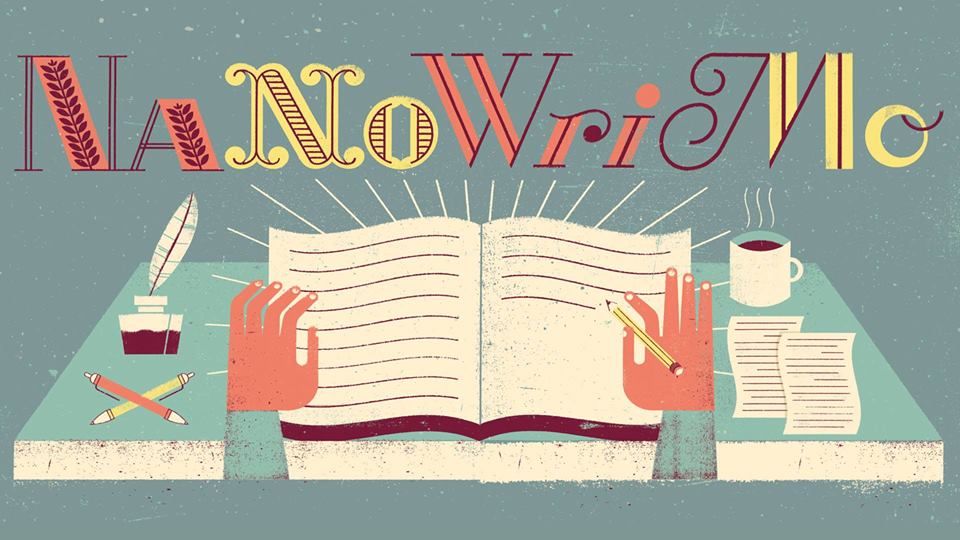
NaNoWriMo is an annual challenge that invites everyone to write 50,000 words in a month. Every November thousands of caffeine fuelled writers undertake the challenge. Some fail. Others win. It’s a tough challenge, especially for those who haven’t participated before. Balancing work, school, hobbies, and commitments among others, on top of writing a minimum of 1,663 a day, seems daunting. But it’s doable, trust me.
Planning:
The problem with writing advice on NaNoWriMo is that I’m probably the worst person to give advice on it. Not because I’ve never won—I have, four times plus some camp sessions—but I can’t plan. Everyone I talk to about NaNoWriMo spends the prior month, or at the very least the prior week, planning their plots, their characters, their subplots. By November, they know what their protagonist had for breakfast on the 8th July 2002. For the first time in a long time, I dedicated a measly two hours to planning; by planning, I mean I took the Myers Briggs test for my main characters. I never plan. Anyone will tell you this is a mistake, but for me its works. I have the vaguest idea of a plot and my characters and I start writing a random scene that I know needs to happen—usually the last. From then on, I write scenes sporadically and piece them together. I let the characters take control. For me, this works; for a lot of people it doesn’t. You need to find a line between a thousand character charts and winging it.
Writing and Editing:
With planning aside, the real fundamentals of NaNoWriMo is, of course, writing. Whether what you write is absolute rubbish or a salvageable manuscript, the point is to write quickly. It’s a marathon. Stopping to edit will only slow you down. You’ve got forever to edit, but only 30 days to write 50,000 words. You can worry about whether you’ve used the right word in the right place later; even minor plot holes can be amended later. It’s a rough draft of a manuscript, not a scintillating piece of literature ready to be handed over to an agent.
Coffee:
Coffee is your best friend. Anything caffeinated should be kept close. I say coffee is your best friend because your social life will probably be dire during this month. Early mornings, late nights, pockets of time between lectures or lunch breaks is all a lot of us can afford to spend on writing. By the end of the month, you might look like you haven’t slept—probably because you haven’t—and coffee will be the only thing getting you through the day. For those of you that can’t drink coffee, I’m so sorry.
Support:
Support is key. You’re going to struggle at time; you’re going to feel exhausted and wonder what the point in it is. Even Victoria Schwab, author of over ten books is branding this year as NaNoFMLMo. Having someone to push you along, or even vent to, is essential. If you need some writers to push you along, there are writing meetings every Saturday in Leeds so you can get your daily dosage of coffee and support.
Resist the urge to read back:
Around the 15—30,000 word mark, I always reach the depths of self-doubt, wondering if what I’ve written so far is unsalvageable, unoriginal, or just unwanted. One time, doubt got the best of me and I threw out 30,000 words and started again. Don’t read it. Don’t doubt. The fact is: the first draft is awful. No one can turn out a perfect first draft. If they can, that’s the closest thing to a superpower I’ve ever heard of. Ignore the doubt; keep writing.
Don’t burn out:
I know the thoughts of self-satisfaction, bragging rights, and the prizes at the end are enticing, but in the wise words of Park and Recreation’s Donna and Tom: treat yourself. Don’t burn yourself out. Take breaks. See people. If you don’t meet the word count, it’s not the end of the world. But forcing yourself will make you resent writing and ultimately make you write slower. Not everyone can write in that time frame and not every story can be written in that time frame. If you feel yourself losing motivation, or just want a break, then stop writing. Grab a snack. Treat yourself.
If you do manage to write 50,000 words this month—or any month—I commend you. It’s not an easy task. And maybe it’s the lack of sleep talking, but it’s worth it.
Paige Johnston
(Image: Erin Morgenstern)